
Important Notice
If you are a doctor, dietitian, nurse, pharmacist, then click on I’m a healthcare professional to proceed. For persons other than Health care professionals, we request you to visit www.danone.in.
By - Mrs. Salome Benjamin
Consultant Dietician and Nutritionist , Director Nutrition Academics-Cuddles Foundation , Mumbai
Iron is one of the important trace element found in human body that actively participates in various metabolic pathways, particularly erythropoiesis and neurodevelopmental processes.[1] Being an important micronutrient for neurodevelopment, dietary iron becomes an utmost vital nutritional component during infancy. Deficiency of dietary iron in early infancy/childhood results in depletion of iron stores in the body that could later result in modification of sensorimotor, cognitive/language, social/emotionaland psychological / behavioural activities in new-borns.[2]Therefore, maintaining iron stores in the body is essential for achieving optimal neural development of babies. ‘Complementary feeding’ serves as an important tool in maintaining and replenishing the iron stores in infants.
Depletion of Iron stores in the body
At birth
In Infancy
Iron Deficiency in Infants
Epidemiology
The iron stores present at the time of birth gets rapidly consumed during first few months of life that exposes new-borns to the risk of developing iron deficiency and anaemia during infancy. The risk of having iron deficiency is particularly higher in preterm infants. Scientific evidence suggests that full-term infants have sufficient hepatic iron reserves for growth and development and do not require supplementation during the first six months of life. However, the iron reserves of preterm infants being comparably less than full term infants, exposes them to greater risk of iron deficiency even during first six months of life. [7] Iron deficiency during infancy could negatively affect the neurodevelopment and haemoglobin status of the baby. The global prevalence of iron deficiency anaemia (IDA) ranges from 25 to nearly 100% among infants; while majority of countries report prevalence rate greater than 70%. [9] As suggested by data from the National Family Health Survey (NFHS) III in India, the prevalence of IDA is as high as 70% among children less than five years of age.[10] Whereas, the prevalence rate of IDA surges to 79% for children under three years of age, indicating vulnerability of IDA in this age group. [10] Severity of IDA among children from age six months to thirty-five months usually vary from mild, moderate, severe, any anaemia (figure-1). [10, 11]
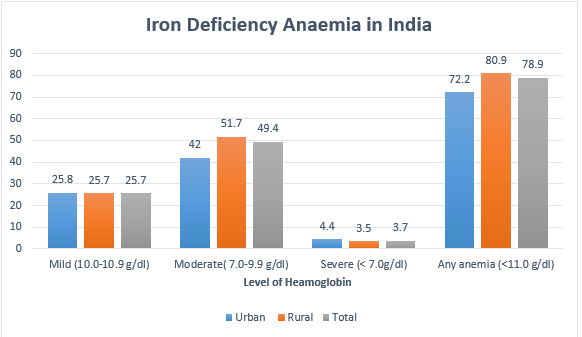
Figure 1
Comparison of Anaemia prevalence among children of age six to thirty-five months (*Adapted from the National Family Health Survey (NFHS) III in India)
Health Outcomes
Requirement of Iron during infancy
Till 6 months of life, iron present in the human breast milk is well absorbed by infants and is sufficient for the formation of heme. However, with marked increase in the nutritional requirement, it is suggested that iron-enriched solid foods should complement breast milk from 7 to 12 months of age. Considering the fact that iron is an essential component required for proper neurodevelopment and physical activity in infants, the Indian Council of Medical Research (ICMR) has recommended dietary allowance (RDA) of iron in infants (Table-1).
Table 1: Iron requirement during infancy
| Age of infant | Weight (kg) | Basal-loss (mg/d) | Blood volume expansion (mg/d) | Skeletal mass | Total mg/d | Requirement µg/kg/d |
|---|---|---|---|---|---|---|
| 0-6 months | 5.4 | Equal to milk iron | Equal to milk iron | – | 0.23 | 46 |
| 6-12 months | 8.4 | 0.12 | 0.4 | 0.21 | 0.73 | 87 |
Source: Adapted from NUTRIENT REQUIREMENTS AND RECOMMENDED DIETARY ALLOWANCES FOR INDIANS A Report of the Expert Group of the Indian Council of Medical Research, 2009
Complementary feeding and Iron Complementary feeding refers to supporting foods that are regularly fed to the infant, in addition to breast-milk, for providing sufficient nutrients. The World Health Organization and IYCF (Infant and Young Child Feeding Practices), 2013 Guidelines recommends that complementary feeding be initiated after 6 months of life.[17] Complementary foods include food products that are either home- made, or manufactured or locally prepared, suitable as a complement to breast milk As per IYCF 2013 guidelines, the complementary feeding must be [18]
Breast milk despite being low in iron content is sufficient to meet the iron requirement of the baby till first six months of life. After the initial six months of life, the iron stores in body of the infant starts depleting fast. Hence, it is recommended that iron enriched complementary food should be given to all the infants along with breast milk after six months of age. [17]
Dietary iron from animal sources (red meat, fish, animal liver, egg yolk) and plant sources (pulses, beans and cereals, green leafy vegetables, peanut butter, iron fortified cereals) can be easily included in daily meal plan of an infant as per choices and preference.
Table 2: Selected Food Sources of Iron (* NIN)
| Food | Milligrams per 100gms |
|---|---|
| Garden cress seeds (Halim) | 100 |
| Gingelly seeds (Till) | 9.3 |
| Radish greens (Muli ke patte) | 18.0 |
| Mustard greens (Sarson ka Saag) | 16.3 |
| Liver | 6.3 |
| Egg | 2.1 |
| Amaranth (Chaulai Saag) | 18.4 |
| Dill leaves (Shepu) | 17.4 |
| Moth bean (Moth) | 9.5 |
| Ragi (Nachni) | 3.9 |
| Bajra | 8.0 |
| Lotus stem, dry | 60.6 |
| Dates, dry | 7.3 |
| Rice Flakes | 20 |
| Bengal gram (roasted) | 9.5 |
| Lentils | 7.58 |
Source: Nutritive Value of Indian Foods, National Institute of Nutrition, ICMR, 2007
However, it was found that the bioavailability of iron i.e. amount of the ingested iron absorbed and utilized by the body is significantly higher in animal sources (up to 22%) as than in plant sources (1-6%) of iron. [17] Dietary iron from animal and plant sources is absorbed better in presence of fructose, and ascorbic acid; while egg yolk, milk, tea or coffee reduces its absorption. Therefore, a diversified diet with reasonable proportions of animal and plant food products along with food products rich in ascorbic acid (25-75mg) is recommended to meet the iron requirements of infants. [17] Complementary food served to an infant should be in sync with iron density recommended for that age group (Table-3). [17]
Table 3: Recommended Iron Density in Complementary food
| Iron Density in Complementary food (mg/100kcal) | Age of Infant |
|---|---|
| 4mg/100kcal | 6-8months |
| 2.4mg/100kcal | 9-11 months |
| 0.8mg/100kcal | 12-24months |
Unfortunately, due to numerous dietary restriction and preferences it is often difficult to meet the recommended iron density in complementary food served to infants. Hence, food fortification, and supplementation of food with iron are considered as best strategies to meet the dietary iron demands in infancy. [17] Additionally including ascorbic acid (vitamin-C) rich foods like orange, guava, lemon, mango, papaya, melon, banana, passion fruit, peach, tomato, green pepper, green leaves, cabbage, broccoli, and cauliflower leaves in daily meals increases the amount of iron absorption in infants. [17]
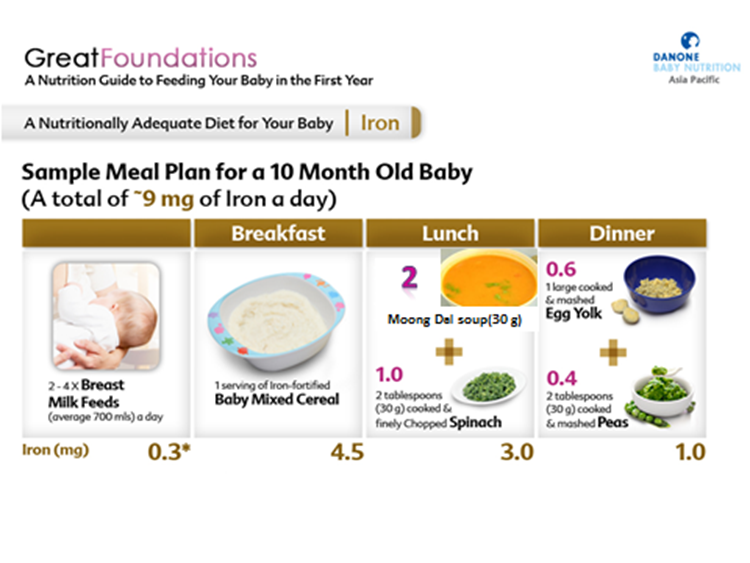
Figure 3: Sample diet plan for an Infant
Table 4: Recommendations on Complementary feeding from IYCF 2013 guidelines
| Age (Months) | Energy needed addition to breast milk (from WHO document)(Calories) | Texture | Frequency | Average amount of each meal | Iron requirement (mg/day) (ICMR RDA) | Iron content (Assuming number of meals/day as advised in column 3) | Food Iron content gap (mg/day) | green leafy vegetables (to be cooked and added to food)(g/day) |
|---|---|---|---|---|---|---|---|---|
| 6-8 | 200 | Start withthick porridge,well mashed foods. | 2-3 meals per day plus frequent Breastfeeding. Depending on appetite offer 1-2 | Start with 2-3 Table spoonfuls increasing to ½ of a 250 ml cup | 5 | 1.0 – 2.0 mg | 3-4 | 25 |
| 9-11 | 300 | Finely chopped or mashed foods, and foods that baby can pick up. | 3-4 mealsplus breastfeed.Depending onappetite offer 1-2 snacks | ½ of a 250ml cup/bowl | 5 | 2.0 – 2.5 mg | 2.5-3.0 | 25 |
| 12-23 | 550 | Family foods,chopped or mashed if necessary. | 3-4 meals plus breastfeed. Depending on appetite offer 1-2 snacks | 3/4 to one 250 ml cup/bowl | 9 | 2.5 – 3.5 mg | 5.5-6.5 | 40 |
Source: Adapted from Guidelines for enhancing optimal infant and young child feedin practices, Ministry of health and family welfare, Government of India, 2013
References:-