
Important Notice
If you are a doctor, dietitian, nurse, pharmacist, then click on I’m a healthcare professional to proceed. For persons other than Health care professionals, we request you to visit www.danone.in.
By - Danone Nutricia academy

Maternal diet, nutritional status during pregnancy, and early offspring diet stimulate subsequent health. In some ways, pediatric nutrition has an easier marker of adequate nutrition than adult nutrition, i.e., growth.1,2 Pediatric nutrition has two primary goals: survival and laying the groundwork for growth and development to optimize health across the lifetime.3 However, pediatric nutrition is more complicated. The caloric requirements fluctuate with age, as do the requirements for specific nutrients2. This article discusses the early intake of excess nutrients and their aftermath
Significant dietary changes occur as the newborn grows into a toddler. This is the age range in which adult-like eating habits are formed over time.2
Excess fat consumption can lead to cardiac disease-
Although cardiovascular (CV) and coronary heart disorders often manifest later in life, atherosclerotic lesions in the aorta and coronary arteries can emerge in childhood and are linked to dyslipidemia and other cardiovascular diseases (CVD) risk factors. In addition, childhood elevated total and low-density lipopolysaccharide (LDL) cholesterol levels are linked to an increase in CVD risk factors in adulthood, including thickening of the carotid artery intima-media, a hallmark of subclinical atherosclerosis, and predicting future cardiovascular events.4
Partially hydrogenated oils, often known as trans fats, are present in a variety of-5
Partially hydrogenated oil is a vegetable oil that has been changed to be solid at room temperature, extending the shelf life of the goods in which it is used. Trans fat consumption has been associated with unfavorable alterations in-5
Dietary habits and preferences are formed in children; therefore, it is critical to intervene early with parents to assist them in making better food choices for their families. Educational interventions should emphasize the negative health impacts of trans fat consumption and the significance of eating a diet rich in unprocessed foods.5
Excess carbohydrate consumption can lead to obesity-
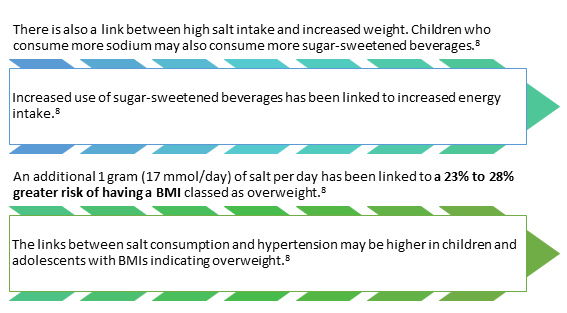
Childhood obesity has reached pandemic proportions. Childhood and adolescent obesity are linked to a variety of cardiometabolic risk factors. Evidence shows that a child’s nutrition has a significant impact on the development of obesity and chronic illness later in life. Furthermore, it has been demonstrated that energy consumption from certain macronutrients has a greater impact on the development of obesity and metabolic problems than total energy intake alone. Recent findings imply that the energy source influences the effect of additional energy on the chance of acquiring cardiometabolic risk factors.6
Early intake of excess sodium and hypertension-
Dietary salt consumption, in particular, is a key modifiable risk factor for hypertension. High-sodium diets induce local and systemic tissue inflammation and compromise gut morphology compared to low sodium consumption. Recent evidence shows that dietary salt alters gut microbial homeostasis by changing the makeup of the gut microbiota.7To maintain circulating blood volume and blood pressure (BP), minimal quantities of dietary salt are necessary. These vital physiological actions in newborns and children need just trace quantities of dietary salt. Children born with low birth weights (2,500 g) may be at a higher risk of developing hypertension if they ingest too much salt as they grow.8
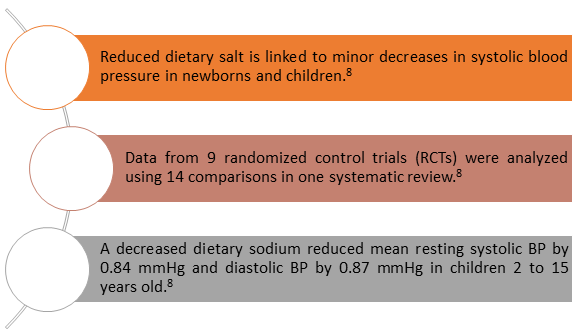
The interplay between salt, sugar, obesity, and hypertension
Nutrition is a vital aspect of proper growth. Children grow and develop; therefore, their optimal diet varies with age. It is also known that diet is a significant factor in disease prevention, particularly chronic illnesses. Unfortunately, many children do not get good nutrition due to unavoidable circumstances. This contributes to children consuming excess nutrient meals, which negatively impacts a child’s growth and health.
For the use of healthcare professionals only. Not for general public.
CVM code – 1654745830076